I've collected 15 stories so far: some were submitted online, others I sat with them and transcribed what they had to say. In neither case were they without prompts, though I tried to keep my input to a minimum and let them explore wherever their thoughts took them. (In one case that resulted in an page of extraneous information I will have to cut, but for the most part people wanted to stay on topic.) Somehow it seems like it came far easier to every single person than it could possibly come to me.
How could I possibly pick out those parts of my life most relevant to my development of sense of self, as shaped by the context of this small geopolitical region? Perhaps they are graced with the freshness of the topic. I've been mulling this over for years, with particular intensity since I began this project. How could I now unthink that which has already been overthought? I could write a book. Some have said I should write a book. I don't have the time and energy to commit to that sort of project, and I would wither away under the spectre of Future Andy, not knowing what would satisfy their judgemental nature.
While interviewing my girlfriend November, they said that nobody in Kosciusko County has ever helped them develop as a person. I wondered why they didn't consider me to be under that umbrella. They pointed out that I was living in St Louis at the time. I said I don't consider my time spent there to be in isolation of the upbringing in K Co that shaped me. They still insisted that they cannot give credit to K Co for that, because if I hadn't lived in StL for a while, I would not myself have been situated so as to bring them there to live with me, which helped them find out who they really are. Two people living in the same household, across two cities, have different perspectives on the same story. Our sense of self is not only shaped by our surroundings, our sense of self shapes our perception of our surroundings. How can one story be the "real" one?
Having gathered the raw stories, I need to edit them for readability. As I read through the stories with an editor's eye, I gather the entirety of the content within my mind, sorting the idea fog into individual little thought clouds shaped like paragraphs. I am interacting with these stories in a way that further aids their absorption where simple reading or even dialog could not. Every interaction I have, every new story I absorb, becomes a part of me and shapes my perception both of myself and of the next story I hear. I feel deeply connected to these people and to my community - I have touched the fringes of the Numinous.
Sunday, March 20

Sunday, March 6
Safety vs Visibility
In working on the Kosciusko County LGBT History Project for class, the question has come up how public to make the public aspect of it. The class is all about creating and occupying public spaces, so leaving that out isn't really an option. One of the things about public spaces is the leveling effect it can have. Conceivably, anyone can walk into a local bar or library and be on the same level as everyone else - nobody gets extra privileges based on their rank or class. However, as many queer and trans folks know, the cost one often times must pay to access this leveling is our authenticity - everyone gets "leveled" as straight. Actual straight people give nothing, but queer people pack away much of ourselves into the closet.
Straight is the presumed default (nobody needs to "come out" as straight) so a plain space is not level by default; gay-only spaces are clearly not level either, as a mix is required for leveling. Visibly affirming diversity seems to be a good solution, in that it gives space for people to know that their identity, whatever it is, is expected to be present. Straight people may not be comfortable, because it feels like their identity is not being celebrated to the same degree that minority identities are. Queer people may not be comfortable, because some are very cautious and untrusting of mixed spaces. Oddly enough, an evenly-distributed level of discomfort might be the truest leveling, as long as prejudice still exists within society.
As I considered where I should hold the physical meeting for this project, I pictured two possible options: an open outdoor venue, or a quiet indoor space. Anything else would begin to incur monetary fees I am unwilling to cover. I was leaning toward the more visible option - I think it would be empowering to gather in a supportive collective, sort of a way to "take back" what ought to be our shared public place to begin with. I have a lot of experience with that from my time spent in St Louis, but I do know that Warsaw residents tend to be a lot quieter, so I decided to check in with local friends before making a final decision.
Most people felt like a quieter space would work better toward drawing people in and allowing them to show a more vulnerable part of themselves. It was also pointed out that the Diversity Rally is going to take place 2 months later. (Initially I had hoped to incorporate my project into the Rally itself, but unfortunately it takes place after our semester ends. I will probably present a reflection on this project at the Rally instead.) St Louis can have a public action every other weekend, but Warsaw tends to get event-saturated rather quickly - many would view it as superfluous, and one event could draw attendance away from the other.
Ultimately I had to ask myself the question: visible to whom? It's easy to experience mission drift during the excitement of what's possible. Over the years of both organizing and providing support to groups and communities, I have learned to watch that tendency within myself and to temper it by reminding myself of my driving principle: service to community and nurturing personal growth within community spaces. As a member myself, I don't feel bad or misguided when my desires are not the majority with other members, since my needs matter just as much. But I do try to check in regularly to make sure I'm spending my energy in ways that edify as many of us as possible.
I think a quiet meeting in a publicly-accessible cafe will have the potential to foster dialog. I say "have the potential", because in my experience, people here still seem to have a skewed idea of dialog that involves talking at the other side, rather than conversing with. But I think Warsaw needs to have a coming of age. Trans and queer people have been here the whole time, but the cloak of silence is only recently being lifted. The population needs to come to terms with our past to accept our present situation and take honest steps forward.
I don't think my family wants a world in which I don't exist, but I don't think they live in a town where their relationship with me and their relationship with conservative Christian culture can yet coexist. Somehow we have to make that possible. The reality is people like me will be the ones who have to do the majority of the labor to build that future, and straight people will probably take credit for the results (much like white people take credit for racial progress), but the alternative is far worse, so I choose to side with hope.
Straight is the presumed default (nobody needs to "come out" as straight) so a plain space is not level by default; gay-only spaces are clearly not level either, as a mix is required for leveling. Visibly affirming diversity seems to be a good solution, in that it gives space for people to know that their identity, whatever it is, is expected to be present. Straight people may not be comfortable, because it feels like their identity is not being celebrated to the same degree that minority identities are. Queer people may not be comfortable, because some are very cautious and untrusting of mixed spaces. Oddly enough, an evenly-distributed level of discomfort might be the truest leveling, as long as prejudice still exists within society.
As I considered where I should hold the physical meeting for this project, I pictured two possible options: an open outdoor venue, or a quiet indoor space. Anything else would begin to incur monetary fees I am unwilling to cover. I was leaning toward the more visible option - I think it would be empowering to gather in a supportive collective, sort of a way to "take back" what ought to be our shared public place to begin with. I have a lot of experience with that from my time spent in St Louis, but I do know that Warsaw residents tend to be a lot quieter, so I decided to check in with local friends before making a final decision.
Most people felt like a quieter space would work better toward drawing people in and allowing them to show a more vulnerable part of themselves. It was also pointed out that the Diversity Rally is going to take place 2 months later. (Initially I had hoped to incorporate my project into the Rally itself, but unfortunately it takes place after our semester ends. I will probably present a reflection on this project at the Rally instead.) St Louis can have a public action every other weekend, but Warsaw tends to get event-saturated rather quickly - many would view it as superfluous, and one event could draw attendance away from the other.
Ultimately I had to ask myself the question: visible to whom? It's easy to experience mission drift during the excitement of what's possible. Over the years of both organizing and providing support to groups and communities, I have learned to watch that tendency within myself and to temper it by reminding myself of my driving principle: service to community and nurturing personal growth within community spaces. As a member myself, I don't feel bad or misguided when my desires are not the majority with other members, since my needs matter just as much. But I do try to check in regularly to make sure I'm spending my energy in ways that edify as many of us as possible.
I think a quiet meeting in a publicly-accessible cafe will have the potential to foster dialog. I say "have the potential", because in my experience, people here still seem to have a skewed idea of dialog that involves talking at the other side, rather than conversing with. But I think Warsaw needs to have a coming of age. Trans and queer people have been here the whole time, but the cloak of silence is only recently being lifted. The population needs to come to terms with our past to accept our present situation and take honest steps forward.
I don't think my family wants a world in which I don't exist, but I don't think they live in a town where their relationship with me and their relationship with conservative Christian culture can yet coexist. Somehow we have to make that possible. The reality is people like me will be the ones who have to do the majority of the labor to build that future, and straight people will probably take credit for the results (much like white people take credit for racial progress), but the alternative is far worse, so I choose to side with hope.
Wednesday, February 17
Preventing Rape
Everyone at IPFW has to take a rape prevention course, and that's what this post is responding to. This post is going to cover some heavy topics, including abuse, rape, and (gasp!) my sex life. If that sounds like too much for you, check out these cute bunnies instead: http://dailybunny.org/ (Seriously, they are adorable.)
My commitment to sexual safety and well-being begins with me. I love my girlfriend very much, and that love is unconditional. What I mean by that is, if they don't want to do something, we don't do it. At all. Maybe they don't want to have sex for a week, a month, a year, ever? That's okay. I'd honestly rather have no sex than bad sex. I'd rather see their smiling face every morning, than guilt them into reluctant sex and the hurt feelings that follow. I know they feel the same in return.
We both are rape survivors. One day I was one of those people who had never been raped, and the next I was asking my husband why he didn't listen to my demands to stop hurting me. (Protip: there's no good answer to that question.) My girlfriend's stories are their own, but were based in an incorrect belief that certain people with certain anatomy are incapable of being raped. My experiences with sexual violence don't define me, but they were difficult parts of my life, and I would never want to make anyone else feel the way I felt.
I already mentioned one way I am committed to a nonviolent approach to relationships: sex is always a benefit of, not a condition for, relationships. Some other principles I carry with me are a constant checking in with my partner for how they're feeling. Do you like what I'm doing? Is there something you'd prefer instead? Talk! Be prepared at any moment to switch to cuddles and reassurance.
I need to have a healthy sexual relationship with... myself. Quite frankly, if I want something done right, I can do it myself. There's no shame in that, and a healthy relationship partner will recognize that. Nobody has the right to pressure me to put an end to "me time", and I have no right to pressure anyone else to press pause on their own sexual relationship with themself either. So if I don't need someone else to get the job done for me, that means I can focus on what is healthy and fun for all of us.
Even though this blog post was about sexual responsibility in particular, these sorts of caring behaviors can be applied to many different aspects of relationships. For example, just as I have no right to make sexual decisions for my partner(s), I have no right to make other relationship decisions for them either. I have a tendency to run a tight schedule, and when I neglect to consult my girlfriend on their time and attention needs, they are left out and hurt by the decisions I have made for them. As long as we are both bringing our needs and wants to the table, with mutual respect and understanding, we will be able to find a solution that maximizes everyone's needs and wants. We both deserve nothing less, and really that's the foundation that makes our love so sweet. ❤

My commitment to sexual safety and well-being begins with me. I love my girlfriend very much, and that love is unconditional. What I mean by that is, if they don't want to do something, we don't do it. At all. Maybe they don't want to have sex for a week, a month, a year, ever? That's okay. I'd honestly rather have no sex than bad sex. I'd rather see their smiling face every morning, than guilt them into reluctant sex and the hurt feelings that follow. I know they feel the same in return.
We both are rape survivors. One day I was one of those people who had never been raped, and the next I was asking my husband why he didn't listen to my demands to stop hurting me. (Protip: there's no good answer to that question.) My girlfriend's stories are their own, but were based in an incorrect belief that certain people with certain anatomy are incapable of being raped. My experiences with sexual violence don't define me, but they were difficult parts of my life, and I would never want to make anyone else feel the way I felt.
I already mentioned one way I am committed to a nonviolent approach to relationships: sex is always a benefit of, not a condition for, relationships. Some other principles I carry with me are a constant checking in with my partner for how they're feeling. Do you like what I'm doing? Is there something you'd prefer instead? Talk! Be prepared at any moment to switch to cuddles and reassurance.
I need to have a healthy sexual relationship with... myself. Quite frankly, if I want something done right, I can do it myself. There's no shame in that, and a healthy relationship partner will recognize that. Nobody has the right to pressure me to put an end to "me time", and I have no right to pressure anyone else to press pause on their own sexual relationship with themself either. So if I don't need someone else to get the job done for me, that means I can focus on what is healthy and fun for all of us.
Even though this blog post was about sexual responsibility in particular, these sorts of caring behaviors can be applied to many different aspects of relationships. For example, just as I have no right to make sexual decisions for my partner(s), I have no right to make other relationship decisions for them either. I have a tendency to run a tight schedule, and when I neglect to consult my girlfriend on their time and attention needs, they are left out and hurt by the decisions I have made for them. As long as we are both bringing our needs and wants to the table, with mutual respect and understanding, we will be able to find a solution that maximizes everyone's needs and wants. We both deserve nothing less, and really that's the foundation that makes our love so sweet. ❤

Tuesday, February 16
Scholarship Essays
It's difficult trying to convince an anonymous panel of judges to give me money. I need the money, so I'll put in the effort! It feels so weird having to write about myself as honestly as possible, but in a way that says "I will use the money you give me for the reasons you wish to give it to me" without sounding fake or whatever.
Section 7. Essays
What are your educational and career goals? How do you plan to achieve them?
My career goal is to serve as an accountant, and my educational goal is to attain the degree in accounting I need to support that career goal. I already have an associates in business, so now I am building upon that educational base. I am a dedicated student who takes every minute of my studies just as seriously as if it were my occupation, because in a sense it is. Once I achieve my educational goal, I also have years of relevant workplace experience I can bring with me to strengthen my future career path and secure stable employment.
Describe why you have chosen your course of study and how you plan to use a higher education to 1) pursue a career, and 2) serve your community.
My course of study is a continuation on my previous workplace experiences. After graduating high school, I immediately entered the US Air Force as an intelligence analyst. There I learned the office skills I was able to take with me to my next places of employment, including the 6 years I worked as a licensed insurance CSR for a small business. That position involved some basic accounting, but I realized that the only way I could achieve accounting as a career goal was through higher education. Once I attain that, I can use my skills to strengthen business in the community. I also intend to connect with charities and nonprofits in the community to offer accounting services on a volunteer basis as I am able.
Describe an aspect of your character you would like the scholarship committee to consider.
My defining virtue is that I have a strong commitment to community. Wherever I am in life, be it in the workplace, a religious community, a support group, or among family, I ask myself "what can I do to strengthen this community and help us grow?" Sometimes this looks like putting in hours of labor for basic support, and sometimes it involves helping come up with and implementing new ideas. I am happy to lead or to follow as my skills are best suited, and I try to reach out to other community members to connect them with areas in which their skills can reach their fullest potential as well. The communities I am in enrich my life in so many ways, and it is my duty to commit myself to the well-being of the people who share that community with me.
(Please give me money.)
Section 7. Essays
What are your educational and career goals? How do you plan to achieve them?
My career goal is to serve as an accountant, and my educational goal is to attain the degree in accounting I need to support that career goal. I already have an associates in business, so now I am building upon that educational base. I am a dedicated student who takes every minute of my studies just as seriously as if it were my occupation, because in a sense it is. Once I achieve my educational goal, I also have years of relevant workplace experience I can bring with me to strengthen my future career path and secure stable employment.
Describe why you have chosen your course of study and how you plan to use a higher education to 1) pursue a career, and 2) serve your community.
My course of study is a continuation on my previous workplace experiences. After graduating high school, I immediately entered the US Air Force as an intelligence analyst. There I learned the office skills I was able to take with me to my next places of employment, including the 6 years I worked as a licensed insurance CSR for a small business. That position involved some basic accounting, but I realized that the only way I could achieve accounting as a career goal was through higher education. Once I attain that, I can use my skills to strengthen business in the community. I also intend to connect with charities and nonprofits in the community to offer accounting services on a volunteer basis as I am able.
Describe an aspect of your character you would like the scholarship committee to consider.
My defining virtue is that I have a strong commitment to community. Wherever I am in life, be it in the workplace, a religious community, a support group, or among family, I ask myself "what can I do to strengthen this community and help us grow?" Sometimes this looks like putting in hours of labor for basic support, and sometimes it involves helping come up with and implementing new ideas. I am happy to lead or to follow as my skills are best suited, and I try to reach out to other community members to connect them with areas in which their skills can reach their fullest potential as well. The communities I am in enrich my life in so many ways, and it is my duty to commit myself to the well-being of the people who share that community with me.
(Please give me money.)
Wednesday, February 10
Trigger Warnings
Last night my girlfriend had a runny nose, so I went and got a mostly-empty roll of toilet paper and tossed it to them. I'm one of those funny people who likes bouncing lightweight objects off of others, so it bounced off their chest. Immediately they started gasping for air like I'd hit them with a fastball. They dove to the ground and gasped for air, wailing loudly and unnaturally. Their brother came running and asked what's wrong. "I'm fine," still wheezing. "Well, you don't sound fine." "I'm sorry." They say that a lot, "I'm sorry," when the PTSD is acting up.
Most people seem not to understand how PTSD really works. In this case, the glimpse of the toilet paper being casually tossed in the air triggered a physical response, due to its visual similarity to the casual toss of a tear gas bomb that they've previously been exposed to. As soon as they were hit with a very lightweight TP roll and not a heavy smoldering cannister, they consciously were aware that nothing was wrong, but by then their body had already involuntarily gone into defense mode: restricting airways to keep the gas out.
They apologize a lot, and it makes me sad, because I'm not the one who deserves an apology. It was a complete accident that I triggered them, and now the best future action is to hand items to them instead of tossing them, to avoid a similar situation. Even saying "hey, here's your toilet paper" and waiting for comprehension before tossing it would have made a difference (oh hindsight). This is what's known as a trigger warning, because it is a warning to precede something that would otherwise be triggering without the warning. That makes all the difference: warning, no trigger; no warning, trigger.
I've seen people get offended by that concept. It really is a weird thing, as though basic medical facts are something non-medical persons should deny on a whim. I've seen it framed as "censorship". I find that odd, because censorship would involve not engaging in the triggering behavior at all, rather than warning about it and then doing it anyway as is typically done.
I've also seen some disagreement between "real PTSD" and "sensitive feelings". Again I find that odd, because it is a medical fact that abusive behaviors sustained over time are as traumatic as brief life-threatening situations. This is known as Complex PTSD. For example, my girlfriend already had sustained trauma from abuse before they ever stepped into a combat zone, and they would never say that the former is somehow more preferable to the latter.
Somewhat more complicated is the issue of exposure therapy, and whether people with PTSD need exposure to recover. First off, this is not always the case. Some patients get worse from exposure therapy, not better. Second, exposure therapy must be supervised by a medical professional! Trigger warnings are used in non-medical settings because we recognize that we're not medical professionals with the ability to regulate a patent's response to the material, and as a result we could be making their medical condition worse.
So who should be using trigger warnings and for what? Clearly if I care about my girlfriend, I should take into account their particular needs. What about my blog? I try not to get too graphic - I could be wrong, but humans often are, and I'm willing to edit anything to add a warning if the need for a particular one is pointed out. What about the classroom? Well, schools are required to comply with ADA accessibility accommodations, and PTSD is disabling, so it's up to the school to work toward making sure everyone has equal access to the same education. Can we adequately warn everyone about everything? Probably not, but aim for the moon, and even if you miss, you'll land among the stars.
Most people seem not to understand how PTSD really works. In this case, the glimpse of the toilet paper being casually tossed in the air triggered a physical response, due to its visual similarity to the casual toss of a tear gas bomb that they've previously been exposed to. As soon as they were hit with a very lightweight TP roll and not a heavy smoldering cannister, they consciously were aware that nothing was wrong, but by then their body had already involuntarily gone into defense mode: restricting airways to keep the gas out.
They apologize a lot, and it makes me sad, because I'm not the one who deserves an apology. It was a complete accident that I triggered them, and now the best future action is to hand items to them instead of tossing them, to avoid a similar situation. Even saying "hey, here's your toilet paper" and waiting for comprehension before tossing it would have made a difference (oh hindsight). This is what's known as a trigger warning, because it is a warning to precede something that would otherwise be triggering without the warning. That makes all the difference: warning, no trigger; no warning, trigger.
I've seen people get offended by that concept. It really is a weird thing, as though basic medical facts are something non-medical persons should deny on a whim. I've seen it framed as "censorship". I find that odd, because censorship would involve not engaging in the triggering behavior at all, rather than warning about it and then doing it anyway as is typically done.
I've also seen some disagreement between "real PTSD" and "sensitive feelings". Again I find that odd, because it is a medical fact that abusive behaviors sustained over time are as traumatic as brief life-threatening situations. This is known as Complex PTSD. For example, my girlfriend already had sustained trauma from abuse before they ever stepped into a combat zone, and they would never say that the former is somehow more preferable to the latter.
Somewhat more complicated is the issue of exposure therapy, and whether people with PTSD need exposure to recover. First off, this is not always the case. Some patients get worse from exposure therapy, not better. Second, exposure therapy must be supervised by a medical professional! Trigger warnings are used in non-medical settings because we recognize that we're not medical professionals with the ability to regulate a patent's response to the material, and as a result we could be making their medical condition worse.
So who should be using trigger warnings and for what? Clearly if I care about my girlfriend, I should take into account their particular needs. What about my blog? I try not to get too graphic - I could be wrong, but humans often are, and I'm willing to edit anything to add a warning if the need for a particular one is pointed out. What about the classroom? Well, schools are required to comply with ADA accessibility accommodations, and PTSD is disabling, so it's up to the school to work toward making sure everyone has equal access to the same education. Can we adequately warn everyone about everything? Probably not, but aim for the moon, and even if you miss, you'll land among the stars.
Tuesday, February 9
Bragging
I currently have a grade of 128% in my commercial law class. This pleases me.

(Sometimes I need to post about things that aren't depressing, ya know?)
Sunday, February 7
VaguePosting
I already have a few responses to my survey on LGBT experiences in Kosciusko County. It's important that people have an anonymous option to tell their stories, because they wouldn't feel safe enough to share otherwise. This means the people who choose to remain anonymous are probably going to share stories that are on the sadder side: people who have to hide a side of themselves or even a person that they love from others, people who are mistreated and can't even stand up for themselves.
I didn't expect it to get so personal, so quickly. I mean, nothing so far is surprising, but it's still a lot to process. A lot of excitement about what it means for the future. A lot of heartbreak over what it means for the present. I feel helpless, because I want to make things better, but doing anything at all (outside of the scope of this project) would make it worse. But being trusted in this way means that I have the opportunity to be a person who is choosing not to cause harm, in a town where it can feel like anyone else with the same opportunity would cause harm.
There's a scene in the film Kinsey (2004) where Liam Neeson depicts Alfred Kinsey having a breakdown, trying to emotionally process the sheer weight of the experiences he's collecting and being crushed beneath them. The filmmakers use imagery of scattered paperwork and physical nakedness and blood: internally he's falling apart, stripped bare, in pain. "I couldn't help them." And the stories he was collecting weren't even those of his people, his community, his loved ones.
I didn't expect it to get so personal, so quickly. I mean, nothing so far is surprising, but it's still a lot to process. A lot of excitement about what it means for the future. A lot of heartbreak over what it means for the present. I feel helpless, because I want to make things better, but doing anything at all (outside of the scope of this project) would make it worse. But being trusted in this way means that I have the opportunity to be a person who is choosing not to cause harm, in a town where it can feel like anyone else with the same opportunity would cause harm.
There's a scene in the film Kinsey (2004) where Liam Neeson depicts Alfred Kinsey having a breakdown, trying to emotionally process the sheer weight of the experiences he's collecting and being crushed beneath them. The filmmakers use imagery of scattered paperwork and physical nakedness and blood: internally he's falling apart, stripped bare, in pain. "I couldn't help them." And the stories he was collecting weren't even those of his people, his community, his loved ones.
Tuesday, February 2
"How Do You Have Sex?"
A classmate's creative blog post reminded me of this question I have been asked fortunately rarely, but unfortunately a non-zero number of times, by people who do not need to know. The succinct answer is "how do I not have sex, amirite!" 😀
The reality is there is no good answer to this question. The person asking has already brought the awkwardness level to 11, at that point I'm already playing a messy clean-up game. I could get embarrassed and feel shamed about all the fake sex I'm apparently having. I could drop everything and whip out the charts and diagrams to prove we trans folk can have real sex too. Or I could laugh at you. Quite frankly, life is too short and I enjoy laughter, so that's probably the option I'm going to go with. 😁
My mother has a sort of underlying anxiety about who I partner myself with, seeing as I'm bisexual and might bring home the wrong set of genitals on accident...? So when I first told her about my current girlfriend, she asked me what gender they are "in their pants". I told her she needs to go find her own genderqueer person to flirt with, November is mine*. 😂
There are circumstances under which it is actually acceptable to ask me how I have sex. Are we friends who are already comfortable talking about general sex stuff together? Are we intending to have sex together, and we actually need to work out the details? Are you yourself transgender and looking for general advice that is unfortunately rather scarce on the internet? Then yes, go ahead and ask if my sexual techniques are something I'd be comfortable discussing with you. 😇
Honestly, I kind of feel sorry for the person asking out of a clear disbelief that there is more than one way to do the sexy times. I kind of want to sit with them a while and hold their hand and say "you poor dear, I know the tunnel seems long and dark, but there is a light at the end, and we can find it together." But maybe that's what this is all about after all: maybe cis people are trying to steal our superior sexy trans moves from us. Well you can't have them! They're ours!! All ours!!! ...Sigh, I guess I'll share, but only if you ask nicely. 😘
*We're not monogamous, but my mother is.
The reality is there is no good answer to this question. The person asking has already brought the awkwardness level to 11, at that point I'm already playing a messy clean-up game. I could get embarrassed and feel shamed about all the fake sex I'm apparently having. I could drop everything and whip out the charts and diagrams to prove we trans folk can have real sex too. Or I could laugh at you. Quite frankly, life is too short and I enjoy laughter, so that's probably the option I'm going to go with. 😁
My mother has a sort of underlying anxiety about who I partner myself with, seeing as I'm bisexual and might bring home the wrong set of genitals on accident...? So when I first told her about my current girlfriend, she asked me what gender they are "in their pants". I told her she needs to go find her own genderqueer person to flirt with, November is mine*. 😂
There are circumstances under which it is actually acceptable to ask me how I have sex. Are we friends who are already comfortable talking about general sex stuff together? Are we intending to have sex together, and we actually need to work out the details? Are you yourself transgender and looking for general advice that is unfortunately rather scarce on the internet? Then yes, go ahead and ask if my sexual techniques are something I'd be comfortable discussing with you. 😇
Honestly, I kind of feel sorry for the person asking out of a clear disbelief that there is more than one way to do the sexy times. I kind of want to sit with them a while and hold their hand and say "you poor dear, I know the tunnel seems long and dark, but there is a light at the end, and we can find it together." But maybe that's what this is all about after all: maybe cis people are trying to steal our superior sexy trans moves from us. Well you can't have them! They're ours!! All ours!!! ...Sigh, I guess I'll share, but only if you ask nicely. 😘
*We're not monogamous, but my mother is.
Saturday, January 30
Warsaw LGBT & Supporters Community
The Warsaw LGBT & Supporters Community are a loosely-organized collective with a minor Facebook presence. Since I'm taking this class to build a skill set in benefit of my community, it makes sense for my project to be in service to that same community. The class discussions with previous student about their projects made me wonder "what if nobody contributes to my project?"
Knowing that my anxiety was based primarily in the fear of the unknown, I decided to reach out to the FB group for some preliminary feedback: "I want to record stories of living as a queer and/or trans person in Kosciusko County - officially for a class project, unofficially because WE'RE WORTH IT DAMNIT. My fear is that nobody will want to share their experiences, even if it's as confidential and anonymous as is possible."
The responses were enthusiastic. People threw out a few ideas, and one member even connected me with a writer for a Kosciusko county newspaper. It makes me glad to see that people want this, and that no matter how broad or narrow the reach of my final project, it is already bringing our community together.
Knowing that my anxiety was based primarily in the fear of the unknown, I decided to reach out to the FB group for some preliminary feedback: "I want to record stories of living as a queer and/or trans person in Kosciusko County - officially for a class project, unofficially because WE'RE WORTH IT DAMNIT. My fear is that nobody will want to share their experiences, even if it's as confidential and anonymous as is possible."
The responses were enthusiastic. People threw out a few ideas, and one member even connected me with a writer for a Kosciusko county newspaper. It makes me glad to see that people want this, and that no matter how broad or narrow the reach of my final project, it is already bringing our community together.
Wednesday, January 27
Black Lives Matter
I don't know if I'll be able to complete the assignment for tomorrow. I don't want to relive the terror of leaving live web feeds streaming while I try to get some sleep, waking up when things get loud, desperately checking the feed to see if I can spot my girlfriend in the rainbow hat I crochet'd for them to know that they're still safe. One time I woke up to everyone trapped in MoKaBe's (a true Third Place), because the owner offered the people protection, so the cops surrounded the building and teargassed unarmed civilians including children. I don't want to relive that moment - a swift google can find you the details. But what I am going to share is a video filmed on the same location, a few nights later. See if you can spot the tall girl in the rainbow hat [bottom-right corner]. See if you can feel the wash of relief that comes from knowing they might return home safe that night.
More information on the speaker in this video, Reverend Osagyefo Sekou, can be find in this Op-Ed for NBC. I'm an atheist, but I hear the spiritual truths resonating in his words:
For young, poor black single mothers, kids with tattoos sagging their pants—anything less than putting your body on the line for them and being willing to pick up your cross in the case of state violence against them is heresy. You betray Christ if you do anything less.Perhaps I can finish this assignment; and if I start to feel I am losing, I can listen to the heartbeat.
Tuesday, January 26
Cultural Genocide
In 1944, Raphael Lemkin created the term "genocide", defining it as “a coordinated strategy to destroy a group of people, a process that could be accomplished through total annihilation as well as strategies that eliminate key elements of the group's basic existence, including language, culture, and economic infrastructure. [0]”
I don't know the history of my people. We seek fragments here and there, guesses based on hints in what documents have survived systemic cover-ups [1]. We were not the subject of academic research, except in the pursuit of a method to eliminate our kind [2].
I have not inherited the traditions of my people. Our stories are re-written with other people in our roles, taking credit for our accomplishments [3]. Our rituals and celebrations are ridiculed and outlawed [4, 5].
I do not get to see examples of people like me living happily ever after. We're the ones who are are disappeared, forced to pretend to be something we're not to blend in, snatched away and hidden in mental institutions designed to "cure" us by slowly killing us, murdered and filed away under another name and identity. [6]
From birth I was told "You do not exist. There are no words apart from slurs for people like you. You have no community. There is no place for you in our schools and workplaces." Strategies that "eliminate key elements of the group's basic existence, including language, culture, and economic infrastructure.”
Forgive me if I don't see this as a matter of "personality differences". [7]
~
[0] Genocide
[1] The history gets fuzzy a few decades before the present. Perhaps scholars may find a few hidden source documents from earlier than that, but most likely family and friends burned any secrets that they didn't want lingering to tarnish their names. History of Transgender People in the USA
[2] Reparative Therapy
[3] Response to Stonewall Movie
[4] Trans Stereotypes in the Media
[5] History of Laws Against Cross-Dressing
[6] You google it. I've already seen too much of this in one lifetime.
[7] I realize any number of black/indigenous/latina, disabled, etc people could have written a similar post that would indict my whiteness, and I don't deny that one bit.
I don't know the history of my people. We seek fragments here and there, guesses based on hints in what documents have survived systemic cover-ups [1]. We were not the subject of academic research, except in the pursuit of a method to eliminate our kind [2].
I have not inherited the traditions of my people. Our stories are re-written with other people in our roles, taking credit for our accomplishments [3]. Our rituals and celebrations are ridiculed and outlawed [4, 5].
I do not get to see examples of people like me living happily ever after. We're the ones who are are disappeared, forced to pretend to be something we're not to blend in, snatched away and hidden in mental institutions designed to "cure" us by slowly killing us, murdered and filed away under another name and identity. [6]
From birth I was told "You do not exist. There are no words apart from slurs for people like you. You have no community. There is no place for you in our schools and workplaces." Strategies that "eliminate key elements of the group's basic existence, including language, culture, and economic infrastructure.”
Forgive me if I don't see this as a matter of "personality differences". [7]
~
[0] Genocide
[1] The history gets fuzzy a few decades before the present. Perhaps scholars may find a few hidden source documents from earlier than that, but most likely family and friends burned any secrets that they didn't want lingering to tarnish their names. History of Transgender People in the USA
[2] Reparative Therapy
[3] Response to Stonewall Movie
[4] Trans Stereotypes in the Media
[5] History of Laws Against Cross-Dressing
[6] You google it. I've already seen too much of this in one lifetime.
[7] I realize any number of black/indigenous/latina, disabled, etc people could have written a similar post that would indict my whiteness, and I don't deny that one bit.
Thursday, January 21
Creeps in Your Restroom!
There is a chance that any time you or your loved ones enters a public restroom, that they could be sharing it with a sex offender. Child molesters, voyeurs/exhibitionists, date rapists - these are all people who buy the same groceries as us, eat at the same restaurants as us, and fill up at the same gas stations as us. If you were the type to be concerned about safety in public restrooms, and believed that legislation were an effective tool to protect restroom patrons (I don't), what could you do about this situation? If your answer is to outlaw transgender people... you just might be Indiana Republican state Sen. Jim Tomes.
In many states, there has never been a law explicitly against using the "wrong" restroom. So why after over 100 years of trans people in multi-user public restrooms (yes, we've always been using them, even if you didn't notice) do we suddenly need laws to segregate and outlaw us? Honestly, it's for the money. This is a great way to scare people into donating money to the political campaign or advocacy organization of their choice. I'm including pro-LGBT orgs here - they use fear tactics to profit from our situation too.
Even if laws were passed explicitly to protect people like me, we still wouldn't be safe. Assault is already illegal, and people still regularly assault trans folks anyway. We cannot be safe in a society that demands segregation. I mean that in the fullest sense. We cannot be safe in a society that demands separate yet equal restrooms. Racial segregation dates back to 1849; separate gendered restrooms came later, in 1887. Segregated restrooms have always been racist as well as sexist, and as such will always be unsafe.
P.S. I figured out how to find the single-user restrooms on campus. It's a solution - inadequate on a societal level, but it's the solution available to me right here right now, so I'll take it.
What about the other sector of society of people that who have all through the decades women been using women’s restrooms and men been using men’s restrooms and kind of like that and kind of expect that level of privacy? Has anyone really been far even as decided to use even go want to do look more like?Forget people who are actually tried-and-convicted sex offenders; the real danger has been me all along! Nevermind that if there really were an epidemic of cross-dressing predators peeping under bathroom stalls, Fox News would be plastering their mug shots all over the scare pieces in a never-ending parade of shame. But the real stories of abuse and violence against peaceful transgender folks in public spaces get pushed to the back pages of news websites.
In many states, there has never been a law explicitly against using the "wrong" restroom. So why after over 100 years of trans people in multi-user public restrooms (yes, we've always been using them, even if you didn't notice) do we suddenly need laws to segregate and outlaw us? Honestly, it's for the money. This is a great way to scare people into donating money to the political campaign or advocacy organization of their choice. I'm including pro-LGBT orgs here - they use fear tactics to profit from our situation too.
Even if laws were passed explicitly to protect people like me, we still wouldn't be safe. Assault is already illegal, and people still regularly assault trans folks anyway. We cannot be safe in a society that demands segregation. I mean that in the fullest sense. We cannot be safe in a society that demands separate yet equal restrooms. Racial segregation dates back to 1849; separate gendered restrooms came later, in 1887. Segregated restrooms have always been racist as well as sexist, and as such will always be unsafe.
P.S. I figured out how to find the single-user restrooms on campus. It's a solution - inadequate on a societal level, but it's the solution available to me right here right now, so I'll take it.
Tuesday, January 19
What Pronouns Do You Use?
The correct thing to do, when one doesn't know or cannot remember a person's name or pronouns, is to ask. I don't know any trans person who has a problem with that question, though many prefer to be asked in private for their own comfort and safety. (More info about pronouns and social etiquette here.) I did actually have a professor refer to me as "they", simply because he did not know what to call me, and in doing so accidentally got my pronoun correct. It is correct to use they/them/their/theirs for me, but I don't expect most people would know without asking.
For a lot of cis people [cis = not trans; trans = not cis], being referred to with incorrect pronouns is rare and easily corrected. For people who do not look like a stereotypical "he" or "she", or people like me who use other pronouns, it would become burdensome were we to explain ourselves or correct others at each new interaction with another human being. Do I say something to the kid checking my groceries? (Who has time?) Do I say something to my girlfriend's parents who won't take a hint from me putting extra emphasis on they when we talk about my GF/their child? (Not all trans girls prefer "she".) Do I want introductions to turn into a tedious Transgender 101 lesson by guest professor Andy Semler every time I step into a new classroom? (Maybe I'll get an honorarium!) I say all this - not because I don't think cis people want to learn, nor do I resent teaching - to illustrate that it really would be a lot of work for me, were I not to let things slide on a regular basis.
I don't think this is unique to trans people. People who speak in an accent other than American Midwest, people who use wheelchairs, etc. are also regularly subject to the question "do I address this situation or do I leave it be?" For each individual, the balance will look different. I tend to save most of my energy for pre-planned settings (like this blog) and for interactions with other trans people and with close friends. As I mentioned on my previous post, we already have so little access to information about ourselves that sharing of myself is a way to give back to the community. Explaining myself to outsiders can sometimes feel like I'm being put on trial; explaining myself to the community is an act of love.
So what can the average person do? Don't stop asking the important questions! Name & pronouns, comfort & safety - nobody can tell you what an individual needs better than that individual. But don't hesitate to learn about the broader issues on your own. "Do you have any educational resources you can recommend?" is a question I wish more people would ask, because it shows a desire to learn more and a respect for my personal time and space. I will put some links in the side-bar to this blog, and recommend this website first: http://transwhat.org/debunked/
For a lot of cis people [cis = not trans; trans = not cis], being referred to with incorrect pronouns is rare and easily corrected. For people who do not look like a stereotypical "he" or "she", or people like me who use other pronouns, it would become burdensome were we to explain ourselves or correct others at each new interaction with another human being. Do I say something to the kid checking my groceries? (Who has time?) Do I say something to my girlfriend's parents who won't take a hint from me putting extra emphasis on they when we talk about my GF/their child? (Not all trans girls prefer "she".) Do I want introductions to turn into a tedious Transgender 101 lesson by guest professor Andy Semler every time I step into a new classroom? (Maybe I'll get an honorarium!) I say all this - not because I don't think cis people want to learn, nor do I resent teaching - to illustrate that it really would be a lot of work for me, were I not to let things slide on a regular basis.
I don't think this is unique to trans people. People who speak in an accent other than American Midwest, people who use wheelchairs, etc. are also regularly subject to the question "do I address this situation or do I leave it be?" For each individual, the balance will look different. I tend to save most of my energy for pre-planned settings (like this blog) and for interactions with other trans people and with close friends. As I mentioned on my previous post, we already have so little access to information about ourselves that sharing of myself is a way to give back to the community. Explaining myself to outsiders can sometimes feel like I'm being put on trial; explaining myself to the community is an act of love.
So what can the average person do? Don't stop asking the important questions! Name & pronouns, comfort & safety - nobody can tell you what an individual needs better than that individual. But don't hesitate to learn about the broader issues on your own. "Do you have any educational resources you can recommend?" is a question I wish more people would ask, because it shows a desire to learn more and a respect for my personal time and space. I will put some links in the side-bar to this blog, and recommend this website first: http://transwhat.org/debunked/
Wednesday, January 13
W422 Blast Off at the Speed of Light
"That sounds like Team Rocket," a friend quips. I had just shared our list of course objectives with them. Of all the classes I've ever taken, this one excites me the most. I think it has the greatest potential to enhance my personal life - I'm a transgender community organizer. Sure my intended degree is accounting and my work history is insurance, but that's just how I earn money. Community building is what I'm doing with my life.
- To create public spaces for creative/critical thought and action
The most difficult part, when I came to realize that I'm transgender, was the complete lack of public examples for me to draw from. How can I know that I'm even possible, if I'm the first one I've ever met? This struck me as deeply unjust (especially since we are everywhere), so I set out to create online space and connect with others who were doing the same. At first it was rough: a small blog here, a tiny group there. But over the years, we reached out to more and more people with the message "you matter to me; I'm here for you".
- To recognize and creatively reframe binary oppositions of thought and language
On the one hand, I'm tired of being expected to remind everyone that I exist, whenever they fall back into binary ways of framing the world. My inconvenient existence doesn't mean I signed up for teaching unpaid lessons on demand. On the other, I can't really avoid the clash that comes when I take up space in a binary world, and it would be better for my mental health to engage in a dynamic that reminds others where their responsibilities lie, in a way that enables both of us to live better lives.
- To work with and against the “enabling constraints” of various forms of discourse
"The Discourse". Every trans person I know refers to it with a tone of scorn in their writing, but we can't help but keep circling back around to it. To a certain extent, the gender binary (the legal and social imposition of a male/female dichotomy beginning at birth) is an enabling constraint. We seek to be liberated from the binary, but while the binary framework still exists, we are able to use its language to describe certain sexist dynamics in ways that otherwise wouldn't make sense. I admit that is circular reasoning and will have to think on this further. I'll have plenty of time for that; The Discourse isn't going anywhere soon.
- To learn how to make good use of diversity and difference as the necessary “friction” of creativity
Oh geez y'all don't even realize. Everyone is trans. I could say "anyone is trans", but I don't think that captures the reality. Think of some kind of person, any kind of person at all: there is someone in existence who fulfills all of those qualities and is also transgender. This creates all kinds of interesting (to say the least) conflicts. For example, most transgender people would like everyone to know that our experiences are vastly different from those of Caitlyn Jenner, but the media keeps portraying her as a trans archetype. The resulting in-community dialog has resulted in all sorts of new understandings of what it looks like when transmisogyny plays out in the media and amongst ourselves, and how we can create healthier messages of support and celebration for our diversity as a collection of unique individuals. This dialog isn't something that will make the headlines, though, not like reality TV celebrities do. Do not expect our revolution to be televised.
- To shape writerly identities that foster both personal growth and social change.
- To understand how discourse is shaped by specific spaces and places and how those assist and/or disrupt community formation.
This was very obvious in St Louis, where the address of the community meeting venue would more or less determine the racial composition of the attendees. Too often I saw meetings advertised for south city, and sure enough it would be 90% white. The black population primarily resided in the north, and were more likely to rely on public transportation, so why didn't we situate more meetings near them and let the white folks with cars absorb the inconvenience? I don't have any nice answers to that question.
- To write yourselves into forms, identities, and spaces that matter to you and that will bring you into deeper engagement with diverse communities.
Tuesday, January 12
Rap is Creativity; Rap is Community
October of 2014, Ferguson October, we gathered in the lawn across from the courthouse, the place infamous for denying Dred Scott his personhood under the law. We are rallying together to mourn what is lost and to build strength for what is possible.
Chants of protesters and activists have frequently been borrowed from rap, and vice versa. "No justice, no peace!" we shout. Then the artists go to their studios and create lyrics that expand their message.
Similarly, people on the streets draw from popular songs for their chants, such as when protesters reminded each other “We gon’ be alright.”
Rap has always been a way to create community space and convey narratives of shared experiences. I'll leave the details to the experts, but here are a few more examples I highly recommend you experience:
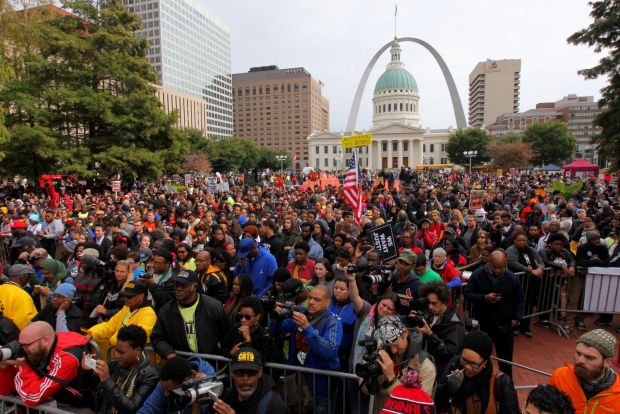 |
| Kiener Plaza, St Louis, MO |
The crowd gets a little more energized. Some people start rapping along. I listen along for a while, then I look around me and observe the physical space we are occupying, and recognize this space as a product of the music.
Woop-woop, that's the sound of da police
Woop-woop, that's the sound of da beast
You need a little clarity, check the similarityThe lyrics are clever, the WHOOP is catchy. KRS-One is taking his experiences and those of his community, and creating a work of art to share with them. Then, by replaying this work at the rally, the community is creating physical space for themselves.
The overseer rode around the plantation
The officer is off, patrolling all the nation
The overseer could stop you what you're doing
The officer will pull you over just when he's pursuing
The police them have a little gunThe physical boundaries of this community space has been delineated by the audible range of the lyrics. Anyone within the space who can hear it will be confronted with its charged message - those who identify with it can stay and share their common values with others, and those who find it hostile to themselves can tolerate their awkward outsider status or leave.
So when I'm on the streets, I walk around with a bigger one
KRS One - Sound of Da Police
Chants of protesters and activists have frequently been borrowed from rap, and vice versa. "No justice, no peace!" we shout. Then the artists go to their studios and create lyrics that expand their message.
Warrior Minded feat. Dramatik - No Justice, No Peace
Similarly, people on the streets draw from popular songs for their chants, such as when protesters reminded each other “We gon’ be alright.”
Protesters Chanting Lyrics
Kendrick Lamar - Alright
Rap has always been a way to create community space and convey narratives of shared experiences. I'll leave the details to the experts, but here are a few more examples I highly recommend you experience:
Queen Latifah, Yo-Yo, Lisa 'Left Eye' Lopes (of TLC), MC Lyte, Patra, Nefertiti, Da 5 Footaz, Salt-N-Pepa, Meshell Ndegeocello and others... the song was a tribute to women of the past like Harriet Tubman, Sojourner Truth, Rosa Parks, Coretta Scott King, Shirley Chisholm, and Angela Davis who played major roles in black resistance, as well as the empowerment of women of the present.
Beyoncé - Ghost
Thoughts on capitalism being at odds with creativity.
Miss Bolivia ft. Rebeca Lane & Ali Gua Gua – Libre Atrevida y Loca
Featuring femmes of all sorts of gender expressions and filmed in Argentina, Guatemala, and Mexico (where Miss Bolivia, Lane, and Ali Gua Gua are from, respectively) .
Angel Haze - Same Love (remix of Macklemore & Ryan Lewis)
The only version of this song anyone ever needs to hear.
Subscribe to:
Posts (Atom)